What is Contra?
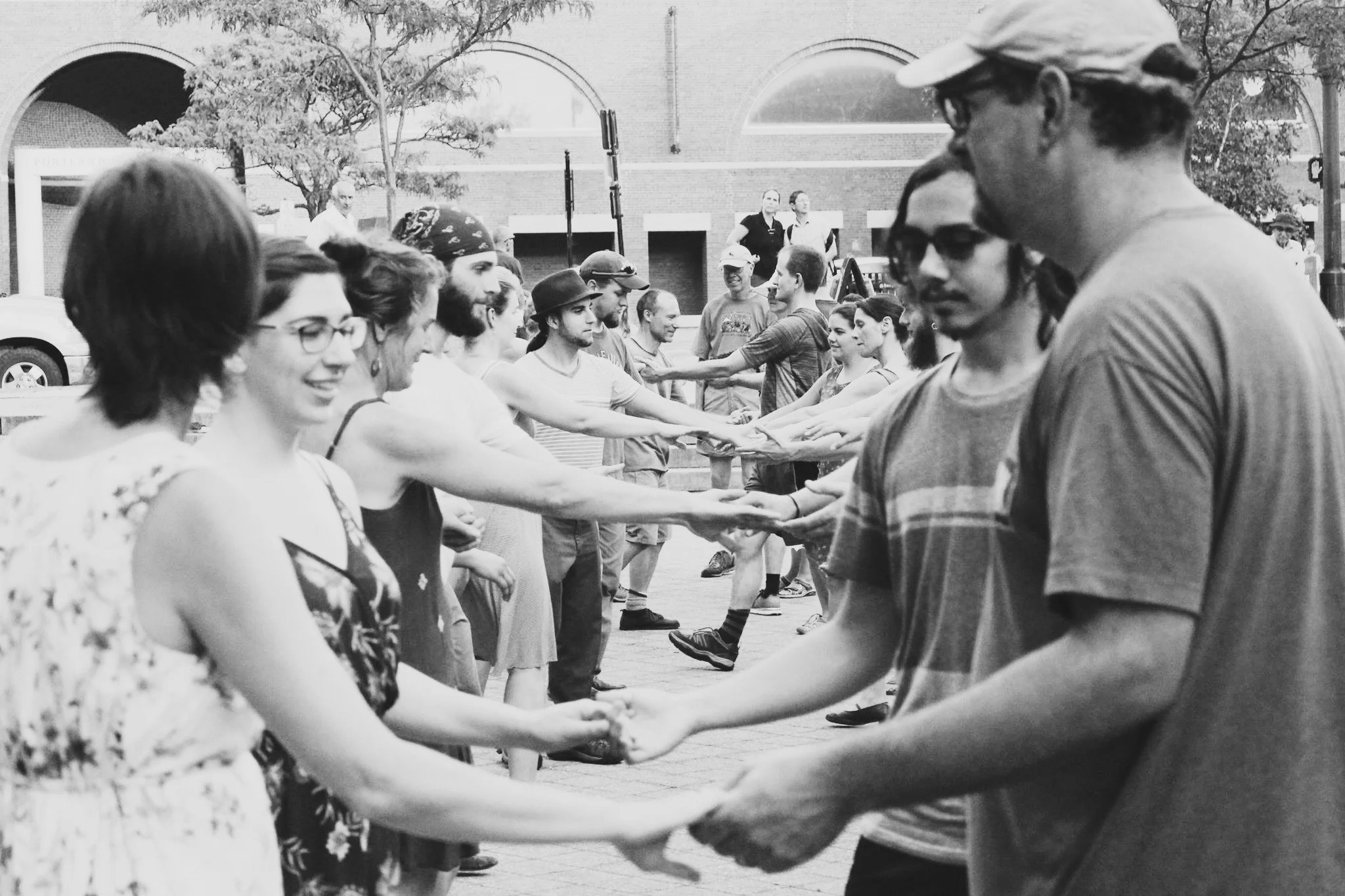
Contra dance is community social dancing to live music. It's lively, joyful, welcoming, and fun!
Most contra dance figures combine a walking step with hand gestures, and these figures are combined into patterns that repeat throughout dances. Each dance is taught and prompted by a caller (teacher), who indicates to dancers what figures they should dance when. Though the dance is proscribed, improvisation is encouraged.
No partner is needed — you dance with everyone! Dancers line up in long parallel lines and, in pairs, make their way down that line, dancing with the other pairs of dancers they meet along the way. Our community is diverse and intergenerational, so you'll meet a lot of different people as you make your way down the line!
People have been contra dancing since the 17th century — in barns, in kitchens, in dance halls, in churches. The dance form is syncretic, a tradition that evolved when European, Black, and Indigenous dance and music forms met and mixed. It’s uniquely American!
Contra is also modern! Because it’s a participatory folk dance, over the centuries contributions from many thousands of artists, organizers, and dancers have shaped the form to keep it relevant. Dances taught at PICD could legitimately be centuries old, or they could have been composed yesterday—using similar principles and figures to keep the through-line. To us today, contra feels bright, unfussy, accessible, and super fun!
MANY Contributions To Contra
EUROPEAN
English, French, Scottish, Irish, and other European cultures are the source of foundational dance forms and figures in contra and some of the approaches to social mixing.
European instruments — like the violin — and instrumentation, musical compositions, tune-choices, and folk music lineage have influenced what’s played and how.
Europeans wrote dance choreography and innovated it through the centuries.
AFRICAN & BLACK AMERICAN
Black Africans and Americans transformed folk social dancing in America. They:
Started “calling” dances live instead of hosting advance classes
Introduced tune “sets” that are open to any choreography, rather than matching specific choreography to a set single tune
Brought novel instruments — including the banjo (banjar) and tambourine (toombah) — and instrumentation — like inventing the “drum kit” and playing the violin as a fiddle
Black musical compositions, tune-choices, and folk music lineage have influenced what’s played and how.
Black artists wrote dance choreography and innovated it through the centuries.
INDIGENOUS AMERICAN
Cultural practices of Indigenous Americans influenced dance formations (namely, circle-style dances) and some of the approaches to social mixing.
Hidden History in American Folkways
What’s under the surface of folk practices? Who is “folk”? What was hidden and why? Who had the power to decide? And why did they make those decisions?
We’re continually asking ourselves these questions and do a lot of exploring to better understand the true history of the folkways we practice.
Part of loving something is seeing it for what it has been and truly is. In order to genuinely practice folk arts in new, transformative ways that enable social justice, it’s critical to examine the ways folk dance and music have been used as oppressive tools.
We invite you to join in the learning.
RESOURCE LIST
This list isn’t exhaustive, and it isn’t expertly curated. It’s simply a place to start looking:
Books
Hoedowns, Reels & Frolics by Phil Jamison
Romancing the Folk: Public Memory & American Roots Music by Benjamin Filene
City Folk by Daniel J. Walkowitz
The Imagined Village: Culture, Ideology, and the English Folk Revival by Georgina Boyes
The Invention of Tradition Edited by Eric Hobsbawm & Terence Ranger
Fakesong: The manufacture of British ‘Folksong’ 1700 to the present day By Dave Harker
African Banjo Echoes In Appalachia: A Study of Folk Traditions by Cecelia Conway
Well of Souls: Uncovering the Banjo's Hidden History by Kristina R. Gaddy
Go Back and Fetch It: Recovering Early Black Music in the Americas for Fiddle and Banjo by Kristina R. Gaddy and Rhiannon Giddens
Fiddling Is My Joy: The Fiddle in African American Culture by Jacqueline Cogdell DjeDje
Way up North in Dixie: A Black Family's Claim to the Confederate Anthem (Music in American Life) by Howard Sacks
Sinful Tunes and Spirituals: Black Folk Music to the Civil War by Dena J. Epstein
The Music of Black Americans: A History by Eileen Southern
Race In Country Music Scholarship by Olivia Carter Mather
Demons of Disorder: Early Blackface Minstrels and Their World by Dale Cockrell
Hidden In the Mix: The African American Presence in Country Music by Diane Pecknold
The Guitar and the New World: A Fugitive History by Joe Gioia
Black Country Music: Listening for Revolutions by Francesca T. Royster
Articles & Online Written Work
”Square Dance Calling: The African American Connection” by Philip A. Jamison
“The Anti-Semitic Origins of Henry Ford’s Arts Education Patronage” by Emery Warnock
Rhiannon Giddens' Keynote Address at IBMA Conference: Community and Connection
Article featuring Rhiannon Giddens, part of which is about Frank Johnson (one of the most popular Americans and fiddlers we've never heard of)
”Ethnicity and Class: Black Country Musicians in the Maritimes” by Neil Rosenberg
”The White Fear of Taking Racist Songs Out of Music Education” by Martin Urbach
“Dinah Put Down Your Horn: Blackface Minstrel Songs Don’t Belong in Music Class” by Katya Ermolaeva
“The Music I Love is a Racial Minefield” by Michael Mechanic
“Accessing the Inside of the Tent: The Optics of Inclusivity in Music Education” by Christopher Mena
“Black Artists Built Country Music - and Then it Left Them Behind” by Andrew Chow
Listening & Watching Online
Bones & Banjo: Confronting Cultural Appropriation at TEDx Dirigo with Kafari and Jake Hoffman
Uncivil podcast "The Song", which explores appropriation and structural racism through the history of the song "Dixie"
American Songster Radio Podcast, hosted by Dom Flemons “American Songster Radio is a monthly look at the roots of American Popular music. It’s hosted by world renowned musician and folklorist Dom Flemons who playfully refers to himself as The American Songster.”
1619 Podcast Episode 3: The Birth of American Music
Rhiannon Giddens and Francisco Turrisi video with Live with Carnegie Hall Giddens and Turrisi go “through the music and history of minstrelsy—the most popular form of entertainment in America during the 1800s and a major influence in the creation of the American cultural identity. The two restore minstrelsy to its global context through the journeys of the banjo and the tambourine, and in tracing those journeys show what there is to reproach versus celebrate in the birth of American music.”
American Folk Podcast featuring Jake Blount, hosted by Cindy Howes
“Country Music” documentary series with Ken Burns The first several episodes relate the stories of early Black originators of country music traditions.
”Wood That Sings: Indian Fiddle Music of the Americas” album featuring Various Artists ”This anthology of Indian fiddle music of the Americas features performances by Indian musicians from Nova Scotia and Manitoba to North Dakota and Arizona, to Mexico, Peru, and elsewhere in Latin America. Using this most popular of instruments as a way to explore the great variety and creativity of Indian musical traditions—from chicken scratch to the indigenous Apache fiddle—this recording expresses the capacity of Native cultures to adapt and synthesize non-Native influences.”
Online Exhibits
"Musical Passage" “Musical Passage tells the story of an important, but little known record of early African diasporic music." "Enslaved Africans and their descendants revolutionized global music historical records tell us far too little about their earliest practices. In this site we offer a careful interpretation of a single rare artifact, from Hans Sloane's 1707 Voyage to the Islands of Madera, Barbados, Nieves, S. Christophers and Jamaica. Tucked away in this centuries-old book, are several pieces of music that make it possible to hear echoes of performances long past."
Organizations & Projects
Modern Folk Music
Jake Blount: Spider Tales (2020) & The New Faith (2022)
Rhiannon Giddens Music: solo albums, Carolina Chocolate Drops, Our Native Daughters, Francesco Turrisi collaborations, and more